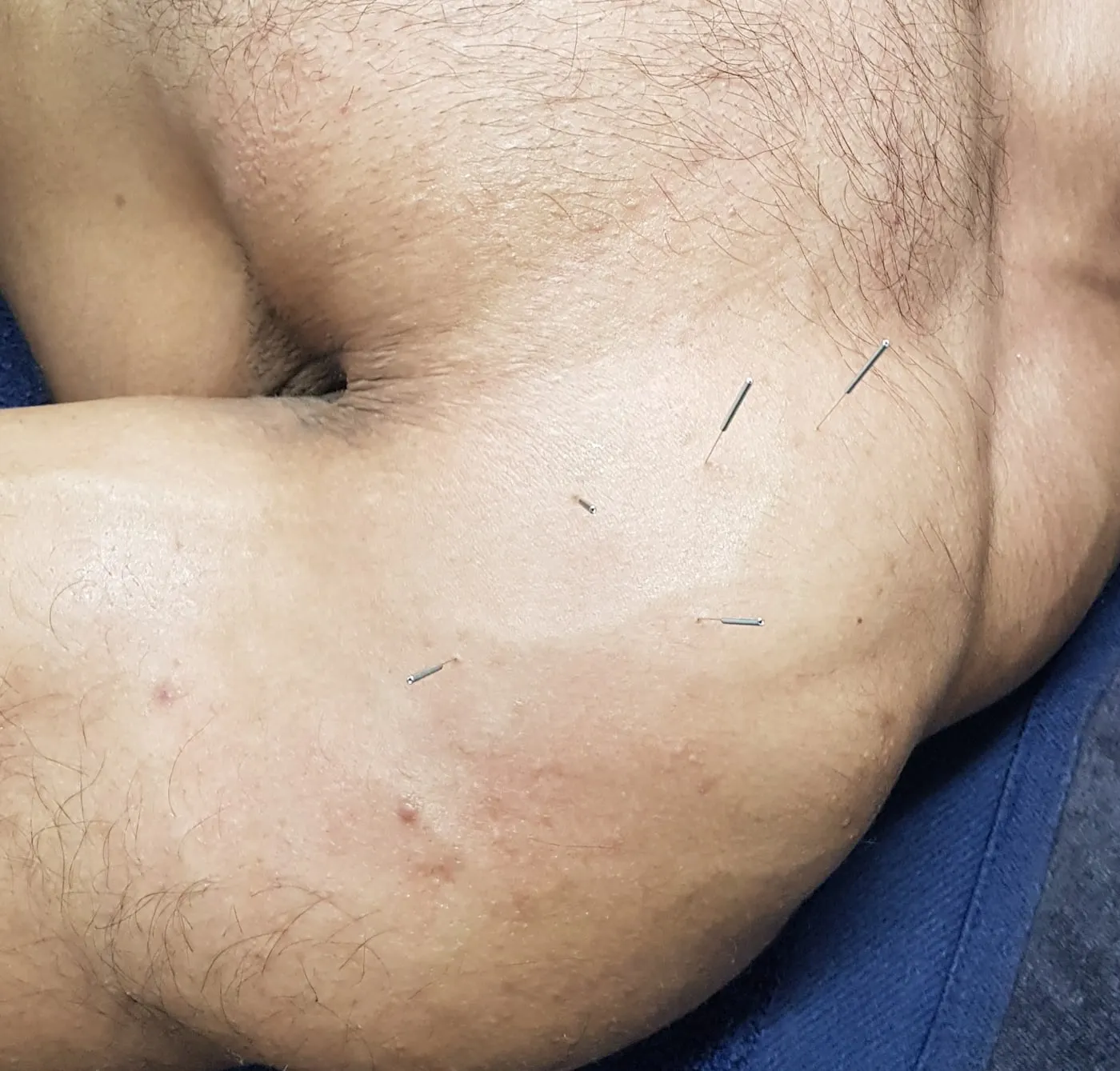
This is medical acupuncture — sometimes called Western acupuncture or dry needling. It uses the same fine needles as traditional acupuncture, but the reasoning is anatomical rather than based on meridians: needles go into specific muscles and trigger points to reduce pain and release tight tissue.
What it feels like
The needles are very fine — far finer than an injection needle — and most people barely feel them go in. What you may feel is a deep, dull ache or a brief twitch in the muscle when a trigger point is reached. That twitch is generally a good sign.
Needles usually stay in for ten to twenty minutes.
Is it for everyone?
No, and there is no need for it to be. It is one option among several, used when it suits the problem and when you are comfortable with it. Plenty of clients never have it. If you would rather not, say so — the hands-on techniques work perfectly well on their own.
Tell me beforehand if you take blood-thinning medication, have a bleeding disorder, are pregnant, or have a pacemaker.
What it is used for
Most often for muscular pain that has not shifted with hands-on work alone: persistent neck pain and tension headaches, stubborn trigger points in the upper back and shoulders, and long-standing tightness where the tissue has stopped responding to pressure.
It is used alongside the hands-on work, not instead of it.
Afterwards
Most people feel a dull ache or heaviness in the area for a few hours, sometimes into the next day. Some feel noticeably tired afterwards and some feel lifted — both are common and neither means anything is wrong. Occasionally a small bruise appears at a needle site.
Take it easy for the rest of the day if you can. Training the same day is usually fine, but not a maximal session.
How many sessions
If it is going to help, you will usually notice something within two or three sessions. If there is no change by then, it is the wrong tool for your problem and we use the time differently rather than persisting with it.
Safety
Single-use, sterile, disposable needles, opened in front of you and disposed of in a sharps bin.
Tell me beforehand if you take blood-thinning medication, have a bleeding disorder, are pregnant, have a pacemaker or other implanted device, have a metal allergy, or have lymphoedema in the area. None of these automatically rules it out, but some change where and whether needles are used.